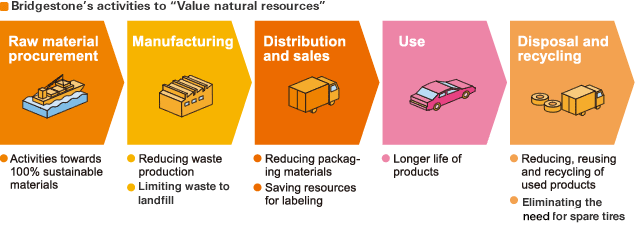
Bridgestone is working to reduce the volume of waste generation and sent to landfill at its production sites in each region, with the target of continuous improvement (1% reduction/year as a guide). In 2025, Bridgestone generated a total of 250 thousand tons of waste, which represents a 12.7% decrease from the previous year. Of this, 14 thousand tons were sent to landfill, at a similar level to the previous year, and the proportion was 5.4%.
As an example of its activities for reducing waste oil from manufacturing equipment, Bridgestone developed a recycling technology for waste oil at the Kurume (Japan) Plant and verified its effectiveness with a local college. The introduction of this technology has led to the reduction of waste oil.
Bridgestone promotes waste reduction with local ownership in each region. For example, in the Europe, Middle East and Africa (EMEA) region, the Burgos Plant (Spain) recycles rubber waste into rubber products for agricultural and horticultural use.
As part of the enhanced drive to improve recycling rates, Bridgestone globally promotes “zero waste to landfill.” In 2010, all 29 manufacturing facilities* in Japan achieved zero waste to landfill status and continue to maintain it.
In the EMEA region, nine plants in Spain, Italy, Poland, and the United Kingdom also achieved the status of zero waste to landfill. Eleven facilities in North and South America achieved the same status. At the Santo Andre Plant in Brazil, the Zero Landfill Project involves finding a solution for recycling and reusing all materials. For plastic packaging, the recycling of materials has improved with new products manufactured from waste, resulting in a 58% reduction through 2025 compared to the 2022 benchmark of new input raw materials. In the Asia Pacific region, seven plants have achieved this status. Bridgestone will continue pursuing initiatives to reduce waste generation and promote beneficial use of waste as part of its efforts to contribute to a circular economy.
Bridgestone’s waste data is verified by LRQA Limited, a third-party institution, to ensure the accuracy and transparency of this information.
* Excluded are wastes that are subject to mandatory processing or have restricted disposal methods as specified by laws and regulations (such as PCB and mercury waste)
Independent Assurance Statement (237KB)
Environmental data