Social
Quality and Customer Value

  • Facebook
  • tumblr

Mission

Creating Customer Value and Trust
We are leveraging a global framework in collaboration with all related Bridgestone entities and stakeholders to proactively identify, prioritize and address customer quality issues in keeping with the intentions of our founder to the Group’s Mission of “Serving Society with Superior Quality”.

A commitment to quality is essential to achieving a sustainable society and providing people worldwide with safe and comfortable living through attractive, high-quality products, services and solutions. This commitment embodies the Bridgestone E8 Commitment. Bridgestone established its Quality Mission Statement to engage every employee in contributing to the creation of high-quality products, services and solutions that exceed customers' expectations through innovation and kaizen (continuous improvement).

The Quality Mission Statement is a blueprint for the future direction of Bridgestone and its leadership. It advances Bridgestone’s proud heritage of quality and commitment to continuous improvement, and it is based on the spirit of its founder, Shojiro Ishibashi, who instilled these values in Bridgestone’s DNA.

Through employee engagement with a commitment toward continuous improvement and innovation, Bridgestone strives to apply the principles of excellence to achieve superior quality throughout the entire value chain, globally across all businesses.

Bridgestone puts the safety of its customers and employees first and delivers products, services and solutions with superior quality.
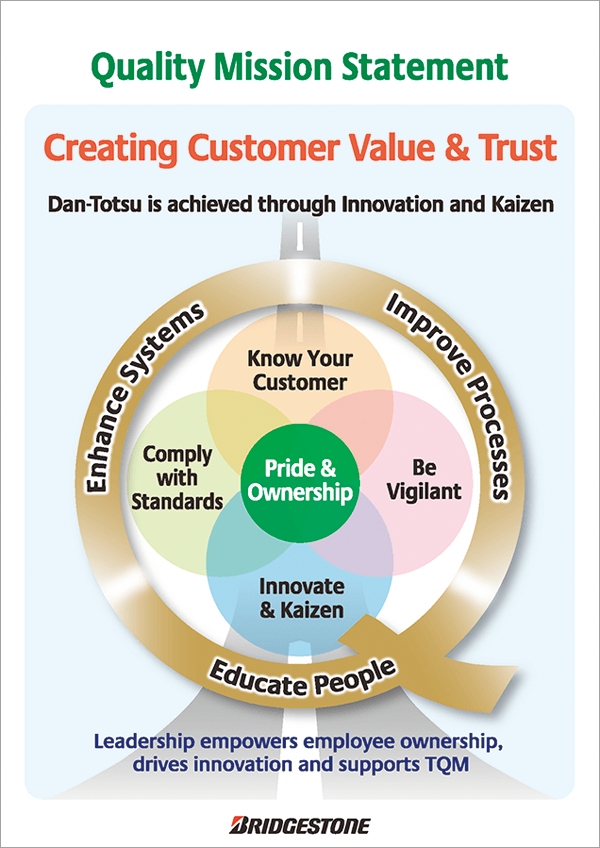
Refined version of the Bridgestone Safety Mission Statement

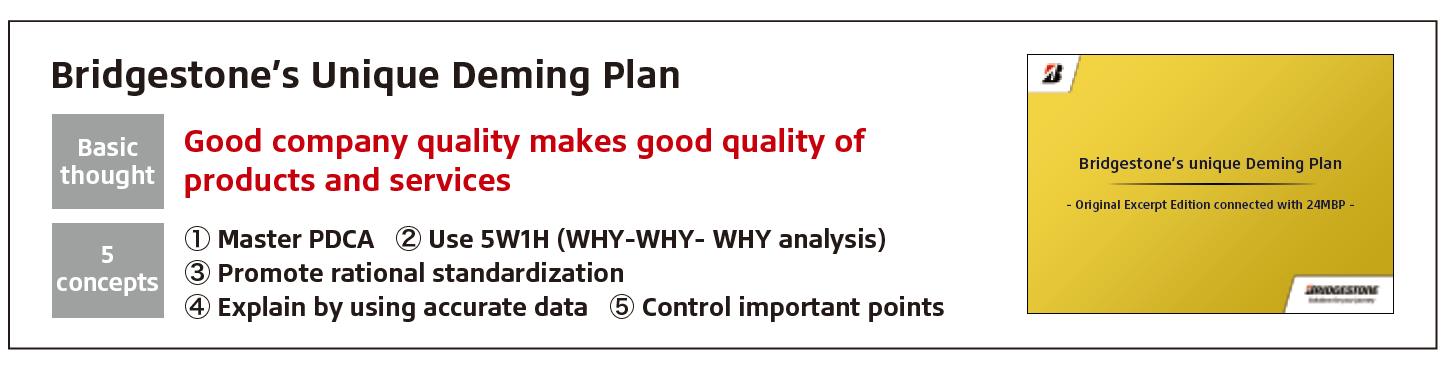
The foundation to reinforce quality management is Bridgestone’s DNA, “Focus on quality,” and its mission, “Serving Society with Superior Quality,” which reflects that DNA. Firstly, Bridgestone will reaffirm and reshare this DNA and return to its origins by reconfirming Bridgestone’s unique Deming Plan. Bridgestone has been promoting this approach since the 1960s, and in 1968, Bridgestone received the Deming prize. The basic premise of the Deming Plan is “Good company quality makes good quality of products and services.” Based on this, Bridgestone is globally reaffirming and resharing five focus concepts of its Deming Plan as the “framework” of thinking:

  • Master PDCA (Plan-Do-Check-Act);
  • Use why why analysis (WHY-WHY-WHY);
  • Promote rational standardization;
  • Explain by using accurate data; and
  • Control important points.

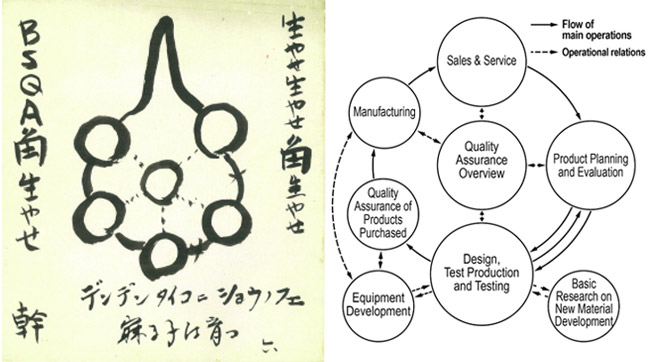
Kanichiro Ishibashi (appointed as president in 1963) used the hand-drawn image below when he initiated a restructuring plan in 1968. This image highlights the importance of quality in all aspects of the business and remains fundamental to Bridgestone’s DNA.

Quality is led by the Quality Management department, but it is a cross-functional responsibility. Bridgestone cannot achieve superior quality standards through just one departmental function. Quality is an outcome of thoughtful interdisciplinary planning and execution, and it is the underlying value of its businesses.

Bridgestone is always looking for ways to strengthen its culture of quality:

  • The Quality Mission Statement has been deployed globally and requires a company-wide commitment—from top executives to newly hired staff—and is the focus of training at least once a year. Bridgestone has implemented awareness and e-learning programs to underscore the active role everyone within the Group must play for Bridgestone to achieve its mission to create customer value and maintain customer trust. To reenforce Bridgestone's DNA, "Focus on quality,” and its global mission, "Serving Society with Superior Quality," Bridgestone will reaffirm and reshare its unique Deming Plan and drive new engagement to all executives and staff.
  • Bridgestone conducts quality education across the organization at least once a year. Specific training modules are delivered to increase competencies regarding quality tools and capabilities. Lean Six Sigma programs, or statistical quality controls, are also implemented at the strategic business unit (SBU) level.
  • Bridgestone places emphasis on managing risks throughout the value chain. In particular, Bridgestone developed a set of standardized quality requirements (called Process Quality Assurance Reference List: PQARL) based on global best practices to mitigate risks and ensure the delivery of the highest quality tire products and services. Since 2020, Bridgestone has expanded the scope of quality requirements in PQARL to include diversified products, bicycles, sporting goods and internal manufacturing business categories to further advance quality improvement.

Goals and KPIs

To achieve its quality and customer value mission, Bridgestone established goals, including:

  • Achieving ISO 9001 quality management system certification at all of its manufacturing sites.
  • Monitoring quality-related items regarding environmental, social and governance (ESG) evaluations using the industry average as a benchmark and disclosing certain ESG milestones.

To achieve the above goals, Bridgestone is promoting the dissemination of the Quality Mission Statement to all employees globally. Bridgestone is developing a quality assurance system that will enable it to produce high-quality products that are friendly to the global environment and minimize waste in the production process of each business site.

Quality assurance system

Alignment with external quality management systems

Bridgestone requires all manufacturing locations in which it has a 50% or more share to achieve and maintain ISO 9001 quality management system certification. As of December 3, 2025, 110 sites had been targeted for ISO 9001 certification, and all sites are certified (Certification acquisition rate: 100%).

To be able to ensure superior quality that meets customer demands, Bridgestone conducts internal and external audits of target business sites at least once a year. It also strives to obtain certifications for international standards, such as IATF 16949*1 and VDA 6.1.*2

  1. International standards for quality management systems specific to the automotive industry
  2. Standards for quality management systems for the German automobile industry

Quality global governance structure

At Bridgestone, based on its Quality Global Governance Structure, a Global Management Platform (GMP) is responsible for disseminating global quality policies and decisions to each SBU. Each SBU is responsible for reliably promoting and implementing the above quality policies and decisions to ensure the quality of products, services, and solutions in the market. These efforts also build a quality assurance system across the entire value chain from product strategy, product development, procurement, production, logistics, sales, and service to deliver customer value and maintain customer trust through innovation and continuous improvement. Moving forward, we will continue to strengthen quality assurance that supports attractive products, services, and solutions, thereby supporting growth accompanied by quality.

Quality assurance throughout the value chain

Entire value chain

Entire value chain

Quality assurance in the development process

To ensure the quality of design and development globally, Bridgestone standardizes and continuously enhances its processes in all technology centers.

Bridgestone leverages the structure and collaboration outlined in the Advanced Product Quality Planning (APQP) process, which includes critical tasks from concept approval through production. The aim is to create a product quality plan for developing and manufacturing products that meet customer requirements.

For quality assurance in the development process, Bridgestone’s aim is to successfully deliver and continuously identify opportunities to optimize the development processes of all product development groups. The scope covers the entire development process, including production processes and manufacturing technology.

In all SBUs at the global level, development processes are structured using a gate-based approach. At each gate, all specified criteria must be met to assure achievement of development targets (including risk analysis) and final product safety and quality.

Quality assurance in raw materials procurement

Bridgestone procures raw materials and outsourced materials from a wide range of suppliers. To maintain and continuously enhance quality assurance throughout the value chain, Bridgestone applies the highest quality standards to all suppliers and business partners (including Tier-N) by requesting their compliance with a purchase contract and its Global Sustainable Procurement Policy. To ensure superior quality, Bridgestone also established Group-wide approval criteria for raw materials and outsourced products.

Each SBU currently holds annual procurement policy briefings related to quality assurance for Tier 1 suppliers. Additionally, to help prevent quality issues at any of its suppliers, the company provides them with guidance for improvement several times per year.

Bridgestone is proud of the relationships it has built with its suppliers. It also continuously monitors the quality of goods received, audits suppliers, and pursues other initiatives to ensure suppliers maintain high-quality assurance systems and supply products that consistently meet its quality requirements.

For more details, see Procurement.

Quality assurance in outsourcing products

Global Business Support and SBUs have been strengthening their cooperation on outsourcing products to improve global quality assurance.

At the global level, Bridgestone is continuously working with its partners and suppliers to enhance the overall quality of outsourced products and deliver superior quality to customers. This includes providing training and other supplier development that instills high-quality standards and criteria which focus on assuring early detection of any potential issues.

Quality assurance in manufacturing

Bridgestone strives to continuously improve global manufacturing processes by introducing innovative technologies to consistently create industry-leading products, services and solutions that meet growing customer expectations.

Bridgestone seeks to identify potential quality risks at its production sites and proactively implements preventive actions using Failure Mode and Effects Analysis (FMEA) quality assurance methods and by focusing on Critical to Quality (CTQ) inputs.

To minimize risks and deliver superior quality products, Bridgestone defines and standardizes quality requirements as a Process Quality Assurance Reference List (PQARL) based on domestic and international best practices. Every year, Bridgestone publishes global quality investment guidelines regarding investments to improve the level of quality assurance necessary to meet these requirements and regularly conducts assessments to confirm the status of implementation at sites.

Bridgestone has established a system to share best practices and continuous improvement activities at the global level to ensure all facilities are aligned on state-of-the-art manufacturing processes.

Promotion of prevention activities

Bridgestone promotes the application of risk-based thinking at all levels of the business based on ISO standards applied throughout the value chain (product strategy, development, procurement, manufacturing, logistics, sales, and service).

Especially during development and production, Bridgestone carries out the Advanced Product Quality Planning (APQP) and performs both Design Failure Mode and Effects analysis (D-FMEA) and Process Failure Mode and Effects analysis (P-FMEA). In parallel, cross-functional teams conduct regular design reviews at each stage of the process.

Bridgestone also conducts continuous monitoring of manufacturing process quality and final product evaluation in order to meet regulatory and customer requirements and its internal standards.

Bridgestone continuously monitors quality KPIs in each SBU to trigger actions at an early stage. It also exchanges best practices and new learnings among all locations to prevent recurrence of quality issues.

Market initiatives

VOC/VOB management

As part of the quest to transform from a “product out” to a “market in” business model, Bridgestone has sought to better utilize the Voice of Customers (VOC) and Voice of Business Partners (VOB), as well as incorporate this management system into the drive to increase customer value. Bridgestone manages the VOC/VOB of each market to suit local conditions and provide the optimal products, services and solutions to its customers.

In Japan, the customer summary system collects VOC from the Customer Communication Center and other relevant departments and shares that information to help improve the quality of Bridgestone products, services and solutions.

Bridgestone Americas (BSAM) and Bridgestone Europe, Middle East, and Africa (BSEMEA) have used commercial market segmentation surveys and Net Promoter Scores (NPS) to help ascertain the degree of consumer satisfaction with tire patterns and devise future product plans. Specific customer value indicators (CVI) have also been useful practical indicators.

Bridgestone will continue building a solutions-driven business model and strengthening VOC/VOB management, with the firm belief that these activities will help improve the quality of products, services and solutions and create added value for customers.

Product / service monitoring

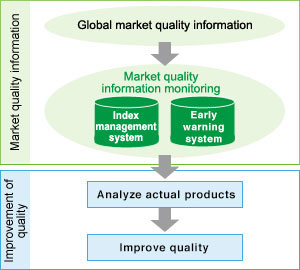
Utilization of market quality information

Bridgestone continuously collects and analyzes data related to the markets (including failures and incidents) for all SBUs.

Bridgestone tires are driven on roads worldwide, so Bridgestone collects data from any available source and promptly shares the information collected and the results of tire analysis with all relevant departments to help improve tire quality.

For example, in cases of passenger car tire wear, Bridgestone proactively collects information by visiting markets, meeting with distributors, analyzing actual tires, and inspecting used tires. It also establishes systems to analyze trends and promptly identify potential concerns, making it possible to act before problems arise in the market. Bridgestone has promoted early detection of potential concerns requiring global and rapid market action , and it has created a rapid response and accurate risk management system designed to facilitate accurate judgments and market action.

Emergent response procedure

As part of Global Quality Governance, Bridgestone utilizes a global CQO system. The CQO system enables each SBU to make rapid judgments based on market information. To identify potential risks and investigate causes in each case, each SBU uses a system for statistically analyzing and periodically evaluating market information. Based on the results, each SBU follows its own detailed procedures and implements the appropriate market response in accordance with Bridgestone standards and the applicable local regulations.

Bridgestone also shares the information globally and strives to prevent recurrence of quality issues within the Group.

Bridgestone will continue to nurture a culture focused on safety and quality, so it can offer consumers the highest quality products that are also safe and reliable.

Product recall information

In case of a product recall, Bridgestone notifies government agencies and discloses information at the following local Bridgestone websites:

Japan (in Japanese)

United States

China (in Chinese)

Please see ESG data for details.

For inquiries, please check the link below or contact the call center designated for each recall.

Contact Us | Bridgestone

In Japan, Bridgestone monitors the state of quality in the market and also collects and analyzes market quality information and VOCs. The company also implements a PDCA approach for early resolution and to implement improvements in accordance with its quality manuals and standards. At other SBUs, potential quality issues and customer complaints are collected and analyzed. In particular, safety issues are analyzed in detail in accordance with local regulations and Bridgestone standards.

Product safety objectives/goals

Bridgestone aims to innovate for sustainable mobility using advanced technologies and solutions. Bridgestone also aims to provide products, services and solutions that support safe and secure movement through the evolution of mobility. To these ends, Bridgestone has implemented a robust Quality Management System at all SBUs and throughout the value chain. Delivering safe products, services and solutions that meet customer expectations is one of Bridgestone’s top priorities.

Bridgestone will continuously expand and evolve its business to meet the changing needs of society and continue supporting the safe and secure mobility and lifestyles of individuals.

New quality assurance system utilizing sensing technology

As a part of its Quality Assurance System evolution, Bridgestone is now promoting Prediction Technology based on analytical data, which leads to higher value for customers and more efficient internal processes. This technology provides useful insights that enable actions at an early stage, improves upstream processes by reducing variations, and predicts and enhances the performance of products, services and solutions. By collecting market data and customer feedback, and applying prediction technology, Bridgestone can manage such data and keep co-creating higher value for customers and wider society.

Quality management in the solutions business

Considering quality to be the value that grows as customers continue to use products and services

In line with changes in the business environment and customer expectations in recent years, the scope of what is considered to be quality has expanded beyond manufacturing to encompass the solutions business as a whole, including improvements in use processes, hands-on trials, and customer experience.

Bridgestone places importance on the understanding that providing value to customers does not end at the moment of delivery, but grows and is amplified as customers continue to use its products and services. Building on this perspective, Bridgestone is pursuing customer-centric quality activities in both the digital solutions and services domains.

Foundation for solutions quality management

Bridgestone has built up the global infrastructure that supports these quality-related activities in stages. It built a quality management system at the Pilbara Mining Solution Center in Australia in 2017 and, with the acquisition of Webfleet Solutions in 2019, established a framework for a global quality management system capable of accommodating new business domains, including through mergers and acquisitions.

As a global common quality management foundation for its solutions business, Bridgestone formulated the Solutions Business Management Guidelines in 2020. Each SBU draws on these guidelines to establish and operate a solutions quality management system tailored to the characteristics of the region and market in which they operate based on these guidelines, supporting the provision of value to society and customers.

Initiatives by business domain

Digital solutions

In the digital solutions domain, Bridgestone believes that delivering a solution to a customer is not the end of the process—rather, continuing to address customer issues through the actual use of the solution is what provides value and constitutes quality.

The value customers expect at the time of roll-out is just the starting point. To consistently generate value while continually monitoring usage and data, Bridgestone incorporates the perspective of making improvements from the design and operation stages, and has put a framework in place that enables it to notice and respond to issues before value is lost.

These initiatives are driven by cross-divisions teams collaborating with the business, development, operations divisions and other related divisions, with the aim of continuing to cultivate value while addressing changes in customer use and expectations.

Services

In the services domain, Bridgestone believes that providing value to customers does not end at the moment of delivery, but is rather something that grows through the ongoing use of services and leads to long-term trust. Its Tire Center stores offer one example of an initiative that embodies this thinking.

For its Tire Center stores, Bridgestone defines service quality as not only accurate work and courteous service, but also being attentive to customer anxieties and concerns, offering a feeling of being valued, and making proposals that surpass customer expectations. In collaboration with Bridgestone Retail Japan, Bridgestone is working both to develop quality frameworks and to change staff awareness and behavior while establishing common guidelines and tools to roll out and instill service quality practices in all stores. It aims to continuously create “customer delight” that goes beyond mere customer satisfaction, and is constantly honing its approach from a long-term perspective.

Going forward

Bridgestone will continue to improve and strengthen quality across the value chain, from digital solutions to services, by positioning the amplification of the customer experience and value at the point of use as a key aspect of quality. In addition to quickly resolving customer issues, Bridgestone will steadily achieve “growth with quality” on a global scale, delivering new value that exceeds expectations.

Talent development to promote quality

Bridgestone believes it is critical to pass on its traditional commitment to quality and high level of acquired skills to future generations. Bridgestone provides quality and product safety training to all employees utilizing various tools and platforms (e.g., e-learning, lecture programs). For operators and inspectors who require specific knowledge and techniques for their work, Bridgestone conducts training programs that include quality control.

Since implementing the Quality Mission Statement in 2016, Bridgestone has been conducting quality-related activities at least once a year based on the statement for all Group Global employees. In all regions of BRIDGESTONE EAST and WEST where annual CSR training programs are conducted, quality management and product safety are also conducted through e-learning. For new employees, quality education that includes the Quality Mission Statement is provided immediately after they join the company. These activities are constantly updated and are being conducted for all employees. These activities and best practices are also shared with other operations to raise the caliber of quality-related activities throughout the Group. Bridgestone also continues to educate employees on its unique Deming Plan, which it has been promoting since the 1960s to reaffirm and reshare Bridgestone's DNA to “Focus on quality.” The basic thought of the Deming Plan is "Good company quality makes good quality products and services." Based on this, the importance of the Deming Plan’s five concepts will be reaffirmed and reshared at each level throughout the global company.

Moving forward, Bridgestone intends to continue developing human resources throughout the company to help ensure customers receive the highest quality products, services and solutions.

TQM activity

”Continuous improvement” is Bridgestone’s global asset, TQM activities for every employee

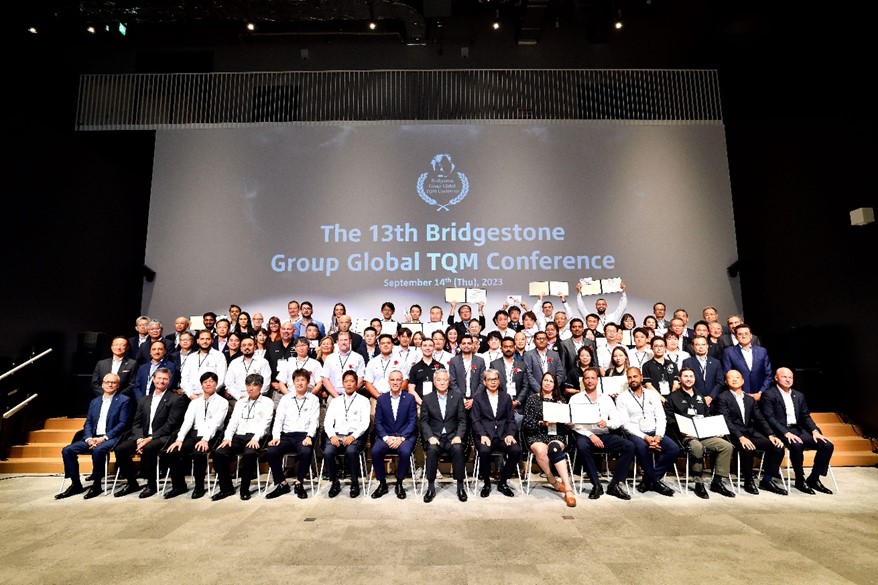
For more than 50 years, Total Quality Management (TQM) activities have been passed down to the whole Group as a culture of continuous improvement and pursuit of innovation. The Bridgestone Group Global TQM conference is held annually for the purpose of enhancing innovation and kaizen through the sharing of best practices related to TQM activities from around the globe to strengthen “improving working and business quality.” The TQM Conference is one of Bridgestone’s representative TQM activities aimed at continuing and promoting the deployment of “improving working and business quality” and thoroughly pursuing operational excellence globally. It has been held with the aim of sharing examples of outstanding and innovative improvement activities throughout the Bridgestone Group and fostering mutual growth for realizing its mission of “Serving Society with Superior Quality.”

The 15th Group Global TQM conference was held in 2025. Among over 2,000 improvement cases submitted from the Group, 16 teams representing various regions and business sites presented their excellent initiatives at the conference.

Award ceremony of the 15th Group Global TQM Conference at the Bridgestone Innovation Park (BIP)

Sustainability