Environment | Reduce CO2 emissions
CO2 emissions reduction in operations Reduce CO<sub>2</sub> emissions

  • Facebook
  • tumblr

Reducing CO2 emissions (Scope 1 and 2) in manufacturing and Transition Plan

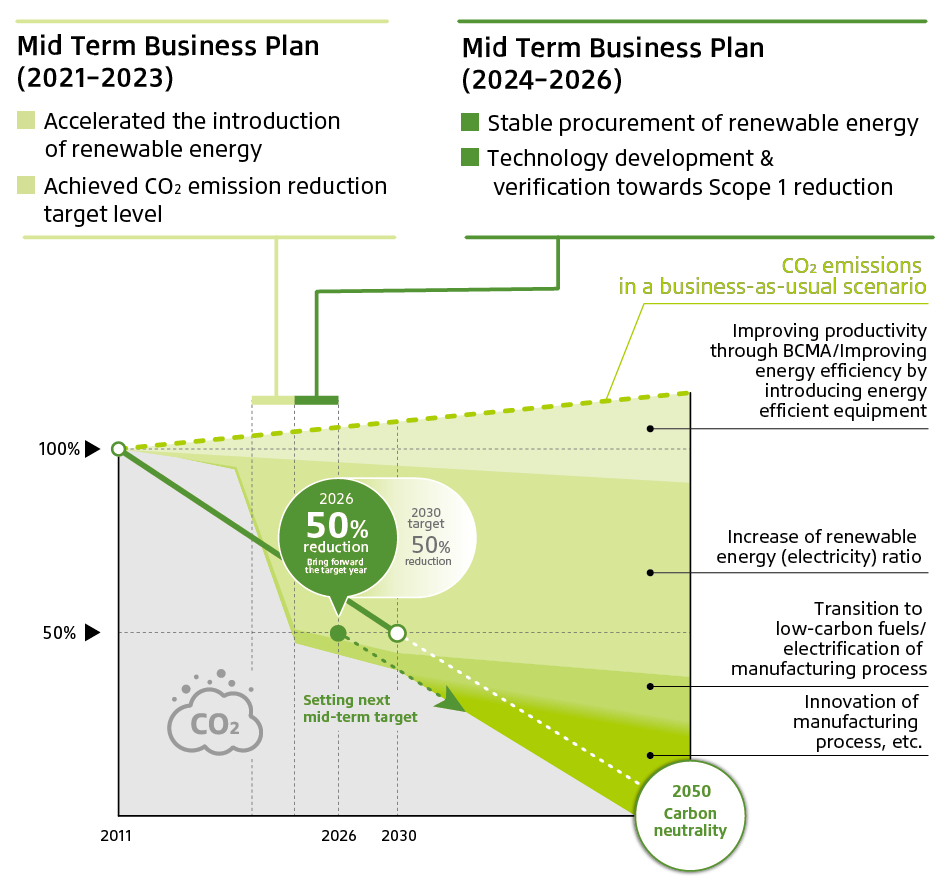
To achieve its goal of realizing carbon neutrality by 2050, Bridgestone has set a target for Milestone 2030 to reduce its absolute CO2 emissions (Scope 1 and 2*) by 50%, compared to 2011. Bridgestone has also set an interim goal of reducing Scope 1 and 2 emissions by 50% or more by 2026 compared to 2011 ahead of Milestone 2030.

In 2025, Bridgestone continued its efforts to improve energy efficiency and introduce renewable energy sources, achieving its 2026 interim target with a 63% reduction compared to 2011, which also exceeds its 2030 milestone. The significant decline was due to ongoing improvements in energy efficiency through energy conservation activities and steady progress in switching to electricity derived from renewable energy and low-carbon fuels. By moving ahead while considering the balance with our businesses, we also improved carbon productivity in 2025 to 2.7 times that of 2021.

The basic structure of the transition plan toward carbon neutrality is shown in the above image. First, the plan assumes the optimization of energy consumption through improved productivity and energy efficiency. Bridgestone will also move forward with the transition by drawing on its core value-creating technologies, such as ENLITEN technology, to differentiate products in conjunction with BCMA technology to simplify production. BCMA in particular supports module sharing across product lines, which helps lower production costs while also achieving reductions in energy consumption and CO2 emissions associated with material changes. For more information on the Mid Term Business Plan, please refer to the Investor Relations page: “Mid-Long Term Business Strategy.

In 2023, Bridgestone’s Pune Plant in India was verified as its first carbon neutral (Scope 1 and 2) tire manufacturing site. The Pune manufacturing facility produces more than four million tires per year. Over the years, the site has reduced its total carbon footprint by 94% through a number of measures. These include solar panels at the plant, the I-REC (International Renewable Energy Certificate) program, and a carbon neutral biomass-based boiler which uses carbon neutral biomass briquettes made from agricultural waste. As part of its PAS 2060 verification, the site has committed to a further CO2 reduction plan for the next three years.

* The target covers emissions from production sites excluding discontinued operations. Scope 1 covers all direct CO2 emissions by Bridgestone (from boilers of manufacturing facilities, etc.). Scope 2 covers indirect energy-related CO2 emissions (from consumption of purchased electricity, etc.). Scope 3 covers CO2 emissions from raw material procurement, distribution, customers’ use, and after-use of lifecycle stages.

Independent Assurance Statement (237KB)
Actual calculation (135KB)

Approval from the Science Based Targets initiative

Bridgestone is enhancing its Milestone 2030 and supplier engagement initiatives to realize carbon neutrality and a circular economy as well as to advance the Sustainability Business Framework, which ensures the link between sustainability activities and businesses across the value chain. Furthermore, Bridgestone is also advancing initiatives toward nature positive within its value chain, thereby evolving its business model into one that is more circular and regenerative.

To accelerate these initiatives, in January 2023 Bridgestone obtained approval from the Science Based Targets initiative (SBTi), which noted that its CO2 reduction targets for 2030 are consistent with the level stipulated in the Paris Agreement (holding the increase in the global average temperature to well below 2°C above pre-industrial levels and pursuing efforts to limit the temperature increase to 1.5°C above pre-industrial levels).

The following near-term targets were approved by SBTi:

  • Bridgestone Corporation commits to reduce absolute Scope 1 and 2 GHG emissions 28% by 2030 from a 2019 base year.*
  • Bridgestone Corporation commits that 92% of its suppliers by emissions (covering purchased goods and services) will have science-based targets by 2026.

* The target boundary includes land-related emissions and removals from bioenergy feedstocks.

ISO 50001 certification

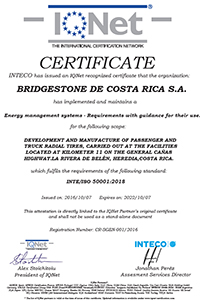
ISO 50001 certificate of San Jose Plant

In May 2012, Bridgestone Europe Technology Center in Rome achieved the first ISO 50001 certification (energy management system certification) in Italy. Bridgestone Europe, Middle East, and Africa (BSEMEA) has been focusing on enhancing energy management. With the ISO 50001 certification of the Britz Plant in South Africa in 2024, certification is now complete at all tire manufacturing plants in BSEMEA, and the Technology Center and Proving Ground in Italy. In addition, certification was obtained by the plants in Izmit and Aksaray (Turkey) and the Pune and Indore plants in India. Other certifications include Thai Bridgestone’s Nong Khae Plant in 2015, Bridgestone (China) Investment’s Wuxi Plant in 2021, and Bridgestone de Costa Rica’s San Jose Plant in 2018.

Bridgestone is working to improve energy management by identifying the major causes of excess energy consumption, defining effective indicators, implementing continuous monitoring in real time (as per the Smart Energy project in Europe), setting targets, promoting awareness among employees, improving the skills of technicians involved with equipment, and engaging in initiatives including forming specialized energy conservation teams.

Transition to renewable energy sources (electricity)

As part of its efforts to achieve carbon neutrality, Bridgestone is striving to expand the introduction of renewable energy in various regions. In Europe in particular, given the well-established renewable energy supply environment in the region, from early on, Bridgestone has pursued the switch to renewable energy and has expanded the use of renewable energy for purchased electricity. By the end of 2022, it had switched 100% of purchased electricity used at all Bridgestone Europe NV/SA (BSEMEA) production sites*1 to renewable energy. Meanwhile, in its Japan, Asia, Pacific, India, China, and Americas businesses, because the liberalization of electricity markets and the diffusion of PPA schemes differ between countries and regions, Bridgestone is steadily raising its renewable energy ratio by combining easily procurable renewable energy certificates and other methods with on-site power generation*2 at its plants. All Bridgestone Corporation plants in Japan had switched to renewable energy for purchased electricity by the end of 2024.

In addition to switching to renewable energy for purchased electricity, Bridgestone is focusing on the roll-out of on-site power generation from the perspective of strengthening sustainable renewable energy procurement and introducing electricity with high environmental value. When considering how to introduce on-site generation, Bridgestone seeks to capitalize fully on private power generation equipment and on-site power purchase agreements (PPAs), taking into account differences in regulations and the feasibility of installation in various regions.

Furthermore, Bridgestone is moving ahead with the introduction of renewable energy at non-manufacturing sites. At its technology centers in Italy and Thailand, Bridgestone has switched all purchased electricity to renewable energy, and in Japan, at the technology center in Tokyo, it has switched the majority of purchased electricity to renewable energy. Bridgestone has also installed solar power generation systems at its Chemical & Industrial Products Technology Center in Yokohama and at its B-Trinity building and B-Innovation sites in Tokyo to generate power on-site.

As a result of these initiatives, by the end of 2025, Bridgestone had completed the transition to 100% renewable energy-derived or low-carbon energy sources for purchased electricity at 63 manufacturing plants globally. Furthermore, Bridgestone exceeded its target of expanding the renewable energy (electricity) ratio*3 to over 70% by 2026, with the ratio reaching 73.5% in 2025. On-site power generation accounts for 3.1% of this total, with annual on-site generation increasing 2.5 times compared to the end of 2023, prior to the start of the 24MBP Mid Term Business Plan. This has helped to reinforce business quality through the optimization of electricity costs. Moving forward, Bridgestone will continue to roll out and optimize renewable energy in each strategic business unit, taking regional characteristics into account.

For information on the use of renewable energy, see ESG Data.

  1. Applies to production sites excluding discontinued operations and sites whose sale or closure has been decided.
  2. Refers to the amount of renewable energy (solar, wind, etc.) generated on Bridgestone premises for in-house consumption, as well as the amount procured through on-site PPAs in which power generation companies install facilities on the premises of Bridgestone, which purchases and uses the electricity.
  3. The renewable energy (electricity) ratio at Bridgestone is calculated using the following formula. The figure includes emissions from production sites excluding discontinued operations:
    (Amount of renewable energy within purchased electricity + amount of electricity generated in-house from renewable energy) / (amount of purchased electricity + amount of electricity generated in-house from renewable energy - amount of electricity sold)

Bridgestone on-site power generation facilities (power generation capacity of 0.1 MWh or more)

Location Products Installed capacity of on-site power generation facilities [MW]
Kurume Plant Tires for passenger cars, light trucks, aircraft, racing cars, and industrial vehicles 1.0
Nasu Plant Tires for passenger cars, motorcycles, industrial vehicles, agricultural machinery, and light trucks 0.8
Hikone Plant Tires for passenger cars and light trucks 1.4
Shimonoseki Plant Tires for mining and construction vehicles 0.8
Tosu Plant Tires for passenger cars and light trucks 2.3
Amagi Plant Tires for trucks, buses, and light trucks 1.7
Hofu Plant Tires for passenger cars, light trucks, and mining and construction vehicles 0.2
Kitakyushu Plant Tires for mining and construction vehicles 5.0
Japan Mold Industry Shimonoseki Plant Tire molds 0.2
Wuxi Tires 13.1
Nong Khae Tires 25.0
Chonburi Tires 22.0
Indore Tires 1.7
Wacol Retreading materials 0.8
Aiken, South Carolina Tires 2.0
Bahia Tires 2.5
Puente San Miguel Tires for agricultural machinery, retreading materials 0.1
Burgos Tires 9.2
Poznan Tires 0.3
Pune Tires 5.0
Rayong Tires for mining and construction vehicles and aircraft 1.3
Chonburi Retread tires for aircraft 0.4
Frameries Retread tires for aircraft 4.2
Changzhou Bicycles 2.5
Saga Plant Steel cord 1.1
Shenyang Steel cord 6.1
Rayong Steel cord 4.5
Songkhla Block natural rubber 1.5

Transition to renewable energy sources (fuel)

Bridgestone utilizes steam in its tire manufacturing processes, using natural gas and other fossil fuel-based energy. There are generally three approaches to reducing CO2 emissions (Scope 1) generated from the use of such fuels:

- Switching fuels (changing from fossil fuels to non-fossil fuel)
- Electrification (converting production processes that use steam to processes powered by electricity sourced from renewable or clean energy)
- CO2 capture and reuse

The type and price of energy available for use vary by region, but Bridgestone to date has mainly pursued approaches based on fuel switching and electrification, aiming to achieve both reductions in Scope 1 CO2 emissions and cost savings.

Installation of Biomass Boilers

As one of its initiatives for reducing Scope 1 CO2 emissions in consideration of regional characteristics, Bridgestone is promoting the conversion of energy sources for heat.

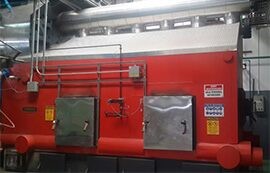
Energy-efficient biomass boiler

Wood pellet biomass fuel

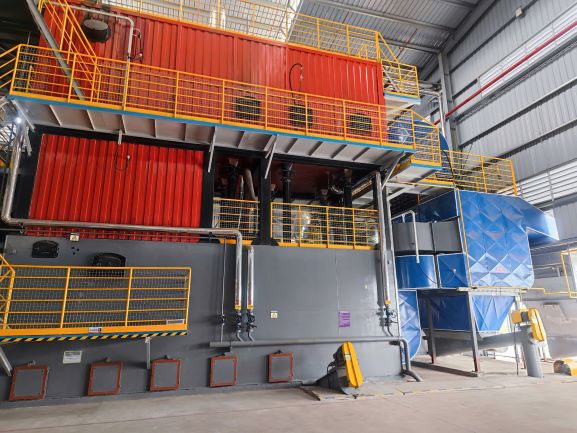
Hai Phong Plant (Vietnam)

Bridgestone Costa Rica (BSCR) introduced a biomass boiler to produce heat for its San Jose Plant in 2014. The company successfully reduced CO2 emissions for the facility by approximately 50% by replacing oil with wood pellets as fuel for the boiler. This BSCR initiative is helping the Republic of Costa Rica achieve its goal of carbon neutrality.

In addition, the Bridgestone India Pune Plant installed a biomass boiler in 2021 to cover 100% of the plant’s steam demand*. Bridgestone Tire Manufacturing Vietnam in Hai Phong shifted to 100% renewable energy from biomass for steam used in production in 2023. This transition is expected to reduce CO2 emissions by approximately 92% compared to the emissions produced by the LPG boiler.

* Except during maintenance

Approach through electrification of thermal energy

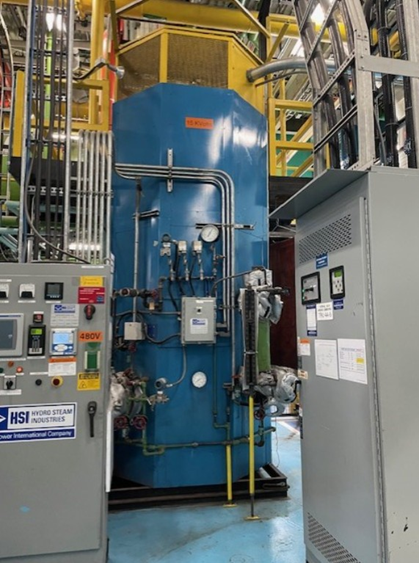
Electric boiler in Joliette

Solar wall in Joliette

To reduce Scope 1 CO2 emissions, Bridgestone uses electric boilers in regions where the renewable energy ratio of grid electricity is relatively high and the CO2 emissions factor of electricity is low.
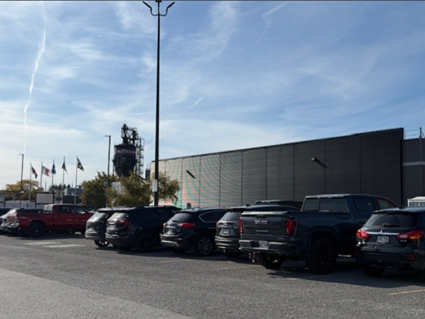
At the Joliette Plant in Canada, early electrification (the introduction of an electric boiler since 2012), a solar wall, and a proactive utility partnership are turning incentives into impact—cutting on-site combustion and accelerating Scope 1 decarbonization.

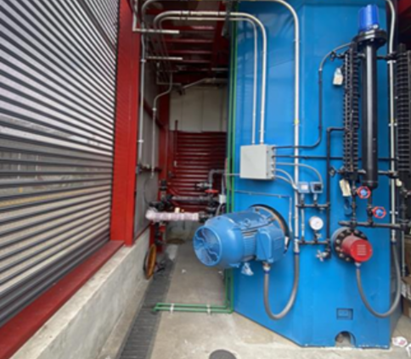
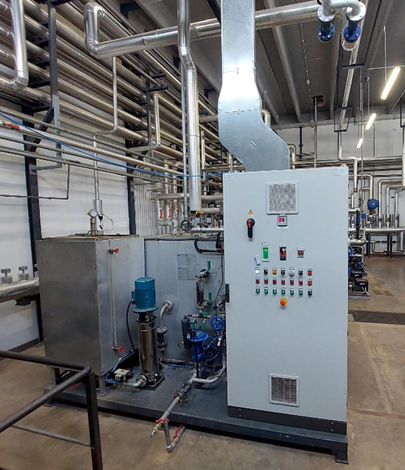
Electric boiler in Costa Rica

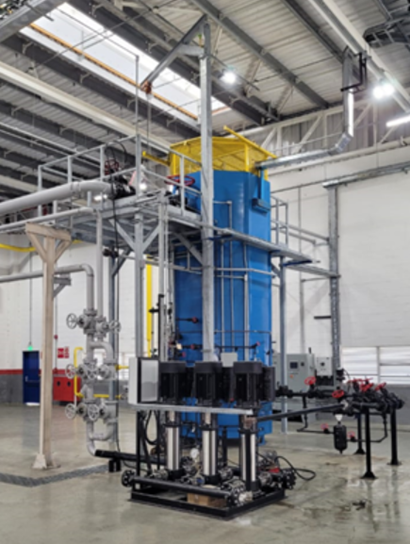
Electric boiler at the Bahia Plant

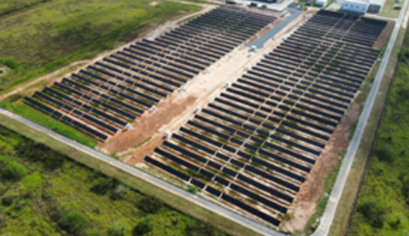
Solar field in Bahia

The San Jose Plant in Costa Rica installed a similar boiler in 2023, powered by Costa Rica’s clean hydropower electricity. The electric boiler now works in tandem with the site’s biomass boiler to supply low-carbon steam for the manufacturing process at a cost benefit to the plant. The Bahia Plant in Brazil completely replaced its conventional fossil fuel boiler with an electric boiler in 2024, in addition to introducing on-site solar power generation.

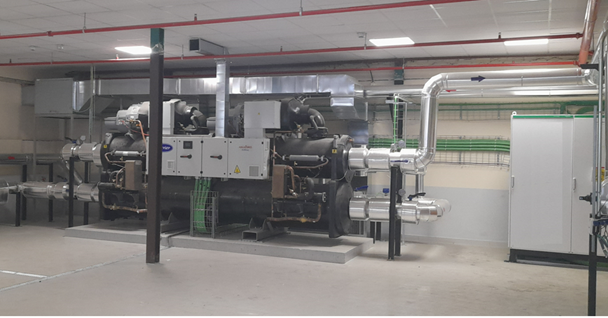
Electric boiler at R&D facilities in Rome

Bridgestone has also installed electric boilers for the steam used at its technology center and pilot plant in Rome.

Heat pump at Burgos Plant (Spain)

At the Burgos Plant in Spain, a heat pump recovers waste heat from the mixing and extruding cooling system and uses it to heat the plant. Since the electricity that powers the heat pump is supplied from renewable energy, this approach contributes to the reduction of Scope 1 emissions.

Group-wide survey to identify energy losses

Energy survey at a tire plant

Even as manufacturing volumes grow in response to demand, Bridgestone will continue to work to reduce its energy consumption to achieve its CO2 emissions reduction goals. Since 2009, its Technology Center has proactively conducted energy surveys to identify energy losses and areas for improvement at plant facilities. Bridgestone is also continuously developing the ability of its employees to recognize and implement energy-saving opportunities. Under Milestone 2030, it aims to improve energy efficiency by 0.5% per year and will continue to promote these activities throughout the Group.

Reducing Scope 3 CO2 emissions from raw materials, distribution, and after-use

In Milestone 2030, Bridgestone set a target to reduce CO2 emissions throughout the lifecycle and value chain (Scope 3) of its products and services exceeding five times its operations’ CO2 emissions (Scope 1 and 2) by 2030 (base year 2020). In 2025, Bridgestone continued to reduce CO2 emissions during vehicle operation and mobility solutions. As a result, the contribution to CO2 emissions reduction was equivalent to approximately 5.5 million tons.* This is 3.2 times the amount of CO2 emissions from operations.

Bridgestone will continue to improve the monitoring of its CO2 reduction contributions of each SBU to expand its overall CO2 reduction activities.

For more details, please see Contributing to CO2 reductions across the value chain.

* Calculated using Bridgestone’s proprietary calculation method based on the Tyre LCCO2 Calculation Guidelines Ver. 3.0.1 (Japan Automobile Tyre Manufacturers Association). Bridgestone’s CO2 emissions are verified by LRQA Limited, a third-party institution, to ensure the accuracy and transparency of this information.

Independent Assurance Statement (237KB)
Actual calculation (135KB)

For detailed emissions data, see ESG Data.

CO2 emissions reduction at logistics facilities in Japan

Promoting a modal shift between the Kanto and Kyushu areas

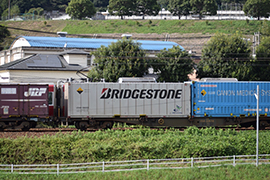
As a large shipper, Bridgestone is working with logistics companies to reduce annual CO2 emissions per energy intensity by 1% on average. For trucks and cars, the Company adopted hybrid and other low-emission vehicles, introduced eco-driving guidance, and increased the size of vehicles to enhance transportation efficiency. It also expanded the round-trip use of containers and vehicles by reducing the return of empty containers and using a comprehensive vehicle allocation system to shorten shipping distances by improving logistics routes. Bridgestone is also working to reduce CO2 emissions associated with shipping from plants to distribution centers through modal shifts, such as switching to rail and ship transportation.

Building certified Gold for LEED®

Bridgestone Americas headquarters

Bridgestone Americas headquarters

In 2018, Bridgestone Tower, the Bridgestone Americas headquarters in Nashville, Tennessee, achieved Leadership in Energy and Environmental Design (LEED®) Gold certification from the U.S. Green Building Council. The 48,588m2, 31-story building is recognized for implementing solutions aimed at achieving high performance in multiple categories: sustainable sites, water efficiency, energy and atmosphere, material and resources, indoor environmental quality, and innovation.

For more information, please see the news release.

B-Innovation building

Bridgestone B-Innovation (Japan)

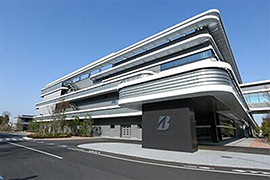
B-Innovation, an innovation center located within Bridgestone Innovation Park (Kodaira City, Tokyo), was awarded LEED® GOLD certification in 2022. Multiple sustainability features were evaluated, including the building design (which achieved an energy reduction of 24.2% from the energy efficiency standard stipulated by LEED), the use of a solar power generation system, and the reuse and recycling of more than 50% of construction waste, etc.

For more information, see the news release.

Relevant information

Other environmental topics

Sustainability