

Sustainability Business Model
Guided by its mission of “Serving Society with Superior Quality”, and positioning 2020 as its “third foundation”, Bridgestone is accelerating its transformation by placing sustainability at the core of its management and business, and promotes business activities with the aim of achieving sustainable growth as a company while contributing to the realization of a sustainable society. In order to realize its vision of “Toward 2050, Bridgestone continues to provide social value and customer value as a sustainable solutions company,” the Group is taking on various challenges and initiatives to build a foundation for sustainable value creation.
By incorporating sustainability into the corporate strategy and the Mid Term Business Plan, Bridgestone is working to establish a unique Sustainability Business Model that links its business with realization of carbon neutrality and a circular economy across the entire value chain, from “produce and sell” and “use” to “renewal” of tires to raw materials.
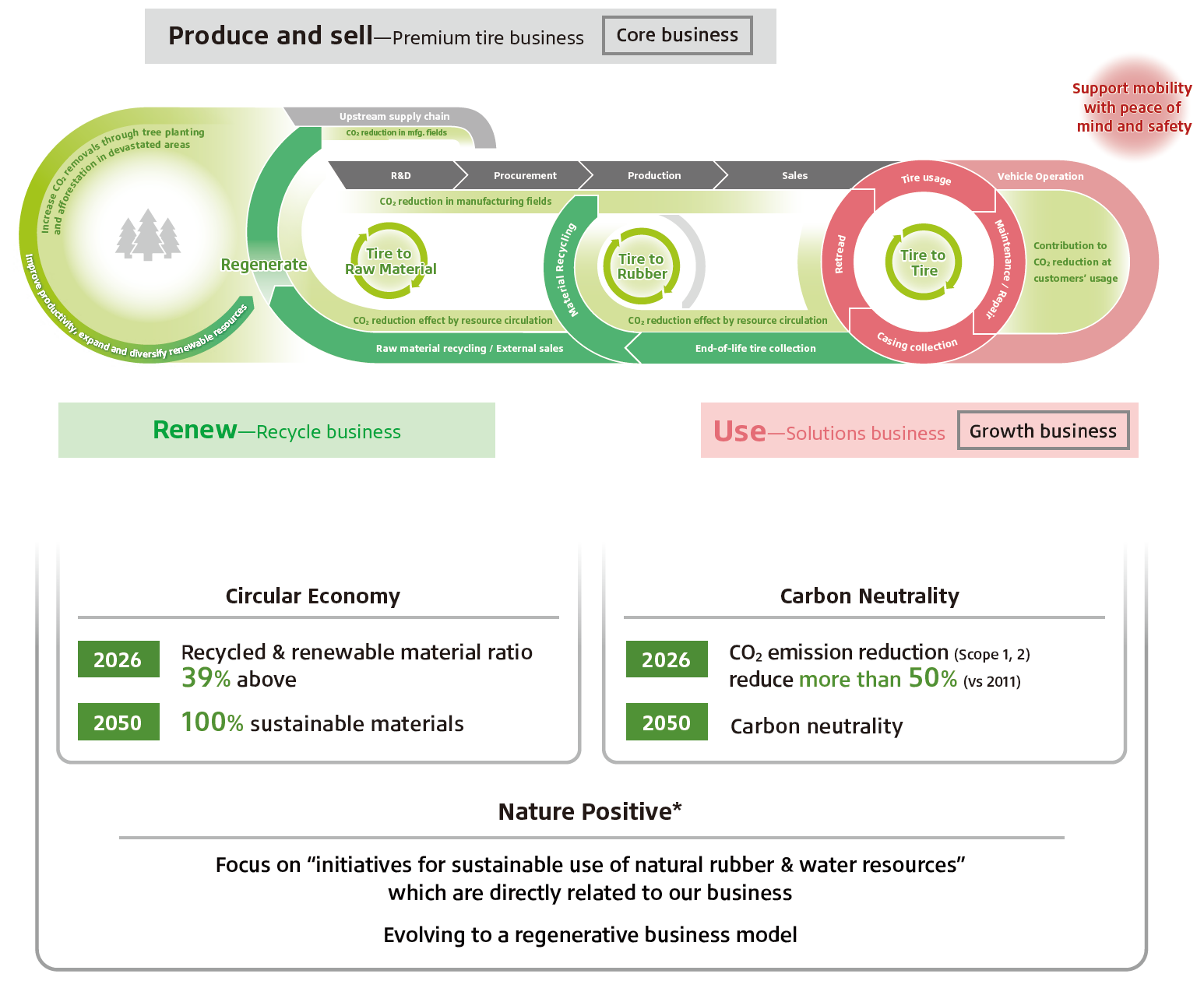
* It means halting and reversing the loss of biodiversity and natural capital in order to put nature on the path to recovery. The intent behind is to reduce the impact of business activities on biodiversity and natural capital, maintain and restore nature’s bounty, and transform socio-economic activities for sustainable use of natural capital.
Over the years, Bridgestone has shown a commitment to living in harmony with nature, based on its Environmental Mission Statement, which was refined in 2011. Bridgestone has been implementing initiatives to achieve its vision of “living in harmony with nature” in order to reduce CO2 emissions and tackle the urgent issue of global warming through technology development aimed at valuing natural resources. Bridgestone set its long-term environmental vision toward 2050 in 2012, and Milestone 2030, its mid-term environmental targets toward 2030 to realize this vision, was announced in 2020.
Bridgestone is pursuing a transition plan that seeks to balance the response to societal demands regarding climate change with measures to strengthen our competitiveness. Rather than viewing carbon neutrality simply as an effort to lower environmental footprint, Bridgestone emphasizes strengthening its competitiveness and business foundation by means of improved energy efficiency, the expanded use of renewable energy, and enhanced product design and productivity, leading to sustainable growth. Bridgestone has set carbon neutrality as a part of its long-term environmental vision for the lead up to 2050. To achieve this, we are advancing initiatives in line with our mid-term environmental targets for 2030: reducing our absolute CO2 emissions (Scope 1 and 2) by 50% and contributing to CO2 emissions reduction across the lifecycle and value chain of our products, services and solutions business exceeding five times our operation’s (Scope 1 and 2) CO2 emissions, using 2020 as the benchmark year.
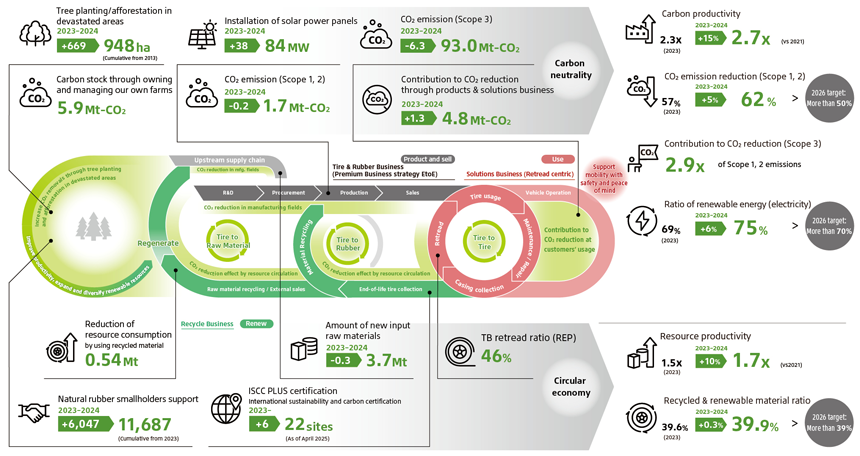
Our rate of CO2 emissions reductions (Scope 1, 2) for 2025 was 63%*1 compared to 2011, exceeding our medium-term target for the third year in a row. The significant decline was due to ongoing improvements in energy efficiency through energy conservation activities and steady progress in switching to electricity derived from renewable energy and low-carbon fuels. By moving ahead while considering the balance with our businesses, we also improved carbon productivity in 2025 to 2.7 times that of 2021.
*1. This figure covers emissions from manufacturing sites excluding discontinued operations (including the Brisa Bridgestone Sabanci Lastik Sanayi ve Ticaret A.S. plant, an equity-method affiliate), and excludes the carbon black businesses in Thailand and Mexico, for which transfer agreements were concluded in 2025.
Taking the lead in the industry, Bridgestone has set mid- to long-term targets to help bring about a circular economy: using 100% sustainable materials by 2050 and using 40% of raw materials made from recycled or renewable resources by 2030. Bridgestone is making steady headway toward achieving these targets. The ratio of recycled and renewable materials reached 40.0% in 2025, exceeding our 2026 target of 39% for the tire business as a whole and reaching the 2030 target level. By making new tire products lighter, extending their lifespan, and capitalizing on recycled materials, we have also lowered the amount of virgin materials by the equivalent of approximately 620,000 tons.
To pursue nature positivity, under the Mid Term Business Plan (2024-2026), Bridgestone is focusing on “initiatives for sustainable use of natural rubber & water resources,” which are directly linked to its business. As its stance for External Environment of Natural Rubber, in 2025, Bridgestone was thus able to renew the targets set in 2023 in relation to its contribution to nature positivity, revising this target to 30,000 smallholders by 2026. In 2025, Bridgestone supported 13,300 smallholders, bringing the cumulative total since 2023 to 24,987 by the end of the year. Bridgestone develops support activities for smallholders in collaboration with local communities, with the aim of improving yields per hector for smallholders and enhancing their livelihoods while contributing to reducing environmental impact at the same time.
To pursue the sustainable use of water, in line with the Water Stewardship Policy, by 2030 Bridgestone aims to develop and implement specific water stewardship plans tailored to the local environment of each manufacturing facility located in a water stress area*1. All 16 such facilities had formulated their own water stewardship plan as of the end of 2025, achieving a combined 3.5% decrease in water withdrawal in 2025 versus the previous year.
*1. Areas with risk of deterioration of freshwater resources in terms of quantity and quality
Outcomes through the Sustainability Business Model (2025 Results)