Social
Human rights, labor practices

  • Facebook
  • tumblr

Mission

Advancing human rights and
responsible labor practices
We will foster an inclusive culture in which all Bridgestone entities and locations adopt and apply ethical labor practices, build trust with our employees, and fulfill our responsibility to respect diversity and human rights.

As part of its dedication to being a true global leader in all that it does, Bridgestone is committed to respecting human rights and advancing responsible labor practices throughout its worldwide operations. Bridgestone believes that this commitment is the right thing to do and that it is consistent with the company’s vision of providing social and customer value as a sustainable solutions company. It is also fundamental to fulfilling the Bridgestone E8 Commitment (one of the values of which is “Empowerment”), by contributing to a society that ensures accessibility and dignity for all. To achieve this aim, Bridgestone is committed to working collaboratively with stakeholders, including affected and potentially affected groups, to address and remedy adverse impacts from its operations, products or services.

Bridgestone continues to embed respect for human rights and the Global Human Rights Policy in its day-to-day operations. The policy articulates Bridgestone’s stance on internationally recognized human rights principles, and it outlines the behaviors that all internal and external stakeholders around the globe can expect from Bridgestone and its business partners. The policy clearly states Bridgestone’s respect for diversity, equity and inclusion, prohibition of discrimination and harassment, focus on workplace health and safety, commitment to responsible labor practices, and protection of freedom of association and collective bargaining. The policy also guides the organization as it strives to uphold human rights principles through interactions with employees, consumers, customers, suppliers, contractors and community members wherever it conducts business. In further support of this policy, Bridgestone is committed to respecting and supporting the UN Guiding Principles for Business and Human Rights (UNGPs), as well as the human rights set out in the International Bill of Human Rights (IBHR) and the International Labor Organization’s Declaration on Fundamental Principles and Rights at Work. Bridgestone also expects its business partners, including suppliers, contractors, vendors, and customers, to uphold the principles set out in this policy. These expectations are aligned with Bridgestone’s Code of Conduct and Global Sustainable Procurement Policy.

The Global Human Rights Policy is endorsed by the Global Executive Committee (Global EXCO) and upheld by the Global CEO, as reflected by his signature on the policy upon its revision in 2022. This demonstrates Bridgestone’s universal and consistent commitment to respecting the internationally recognized human rights principles laid out in the aforementioned international standards.

This mission is important to Bridgestone, as stakeholders and society increasingly hold businesses, and especially large global organizations, accountable for their specific human rights commitments and subsequent actions. Bridgestone proactively incorporates human rights initiatives into its business models and across its value chains, priorities, management policies, and business strategies. With these actions, Bridgestone is creating social and customer value and building trust with stakeholders.
Global Human Rights Policy

The Group’s Global Human Rights Policy

Group initiatives to address various human rights issues based on the Global Human Rights Policy.

The Bridgestone Group Global Human Rights Policy (77KB)

Management structure

Bridgestone’s commitment to respecting human rights is upheld and led by the Global EXCO, the highest-level committee overseeing its business strategy and execution. This committee is chaired by the Global CEO. In terms of management and execution, committees have been established based on management strategy and issues, and each committee promotes initiatives to resolve issues across the regions and organizations. In the area of sustainability, several related committees, including the Sustainability Committee, organize the holistic Sustainability Framework and design and implement sustainability initiatives, including initiatives related to human rights and labor practices.

As a part of the Sustainability Committee, the Human Rights, Labor Practices Working Group (HRLP WG) is responsible for putting Bridgestone’s commitment to upholding the above internationally recognized human rights principles into practice in each Strategic Business Unit (SBU) and regional office. The HRLP WG is composed of senior human resources leaders from each SBU, supported by dedicated human rights functional resources based at Bridgestone’s Tokyo headquarters. The HRLP WG plans and manages human rights initiatives, such as the human rights due diligence process, implementing the Global Human Rights Policy, and assessing, preventing, mitigating and reporting human rights risks related to business conduct. The HRLP WG also collaborates with the Global Procurement Committee and the Environment Working Group to holistically address human rights issues across the value chain. The HRLP WG reports on its progress and plans to the Sustainability Committee at least quarterly to ensure that senior management is consistently informed of all significant human rights developments and initiatives.

Goals and KPIs

2022-2025 performance and 2026 goals and KPIs

To achieve its human rights and labor practices mission, Bridgestone has set the following goals and KPIs:

2022 2023 2024 2025 2026
(Goal)
Application of Implementation Guideline for the Global Human Rights Policy*1 - 100%
107 Group Companies
*Updating the Implementation Guideline 100%
146 Group Companies*3
100%
162 Group Companies
Human Rights Risk Assessment Survey (HRRAS)
completion rate*2
100%
104 Group Companies
100%
107 Group Companies
100%
146 Group Companies*3

100%
162 Group Companies

HRRAS will be conducted in 2027

Confirmed violation of forced labor and child labor 0 0 0 0
  1. Application of the Implementation Guideline for the Global Human Rights Policy against targets
  2. HRRAS completion against assessment targets
  3. The original number of targets estimated in June 2025 was 175. This number was later re-evaluated and reduced to 147 due to the restructuring and consolidation of targets following changes in the management structure in October 2025.

Bridgestone’s progress in and improvements to its human rights due diligence processes were recognized in the form of significantly enhanced evaluations from external indices. Bridgestone will continue efforts to ensure it meets its commitment to respect human rights throughout its operations, and anticipates these efforts will in turn result in higher external evaluations in 2025 and beyond.

Human rights due diligence for Bridgestone’s operations

Human rights risk management approach

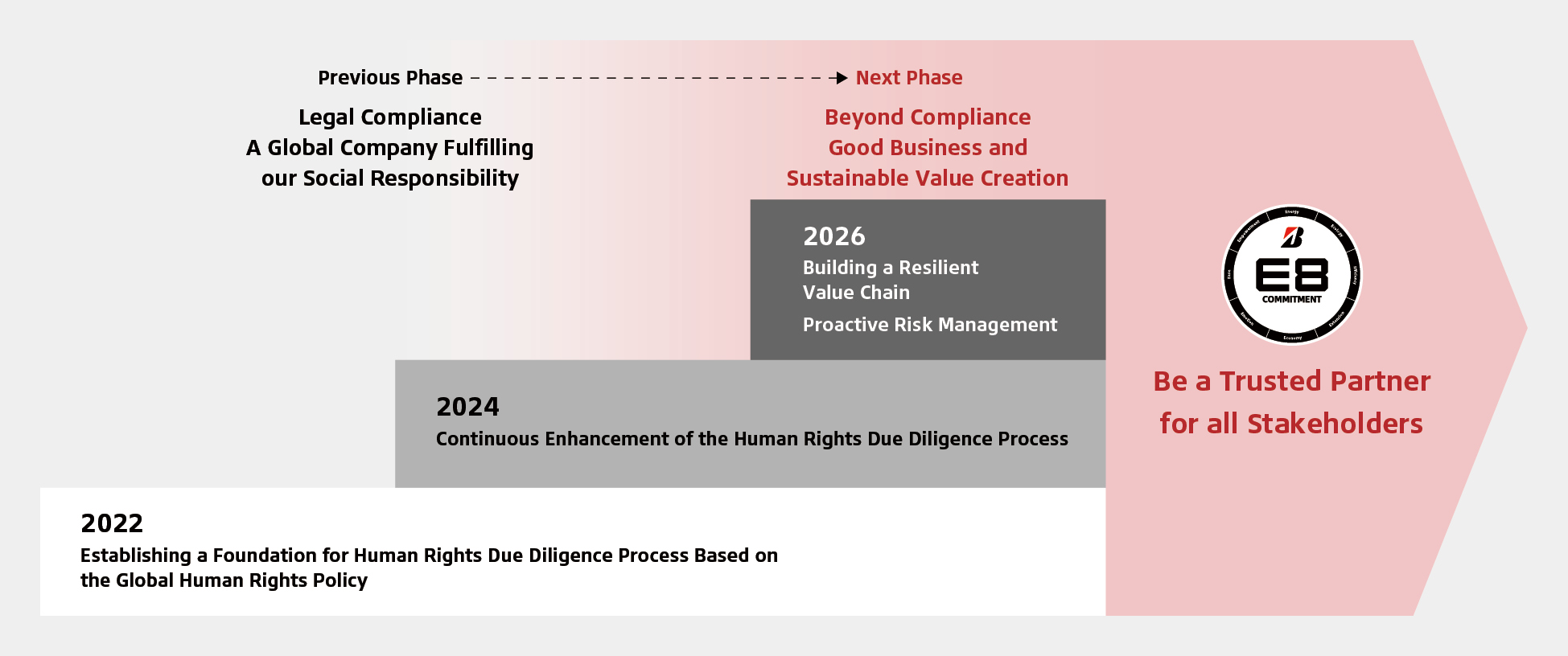
Bridgestone has consistently improved its human rights due diligence system and processes. Following the revision of the Global Human Rights Policy in 2022, Bridgestone established a foundational system to uphold its commitment to respecting human rights. In partnership with external human rights experts, SBU leaders, and local employees, Bridgestone has conducted a PDCA cycle through a balanced “glocal” approach and further enhanced its human rights due diligence system globally to effectively prevent and manage critical human rights risks. Since starting to build the foundation in 2021, Bridgestone has improved the system that enables Bridgestone to uphold its accountability as a global corporation. Going forward, Bridgestone will continue efforts to reinforce the due diligence system to prevent, mitigate, and control human rights risks across its operations, while foreseeing and adapting to evolving social conditions and business environments as well as to stakeholder expectations. Bridgestone believes that its human rights commitment and efforts will create good business quality and a more resilient value chain. Bridgestone’s efforts also underpin its sustainable value creation and business operations while contributing to market and business practices to ensure that mainstream products are free of human rights risks. To be a Trusted Partner for society, customers, and all stakeholders involved in its business, Bridgestone will continue advancing its commitment to respecting human rights.

Human rights due diligence process

Bridgestone has established and regularly implements a human rights due diligence process throughout its operations and supply chain. For an overview of human rights and environmental due diligence processes and actions across the value chain, please refer to Bridgestone’s Holistic Due Diligence Approach.

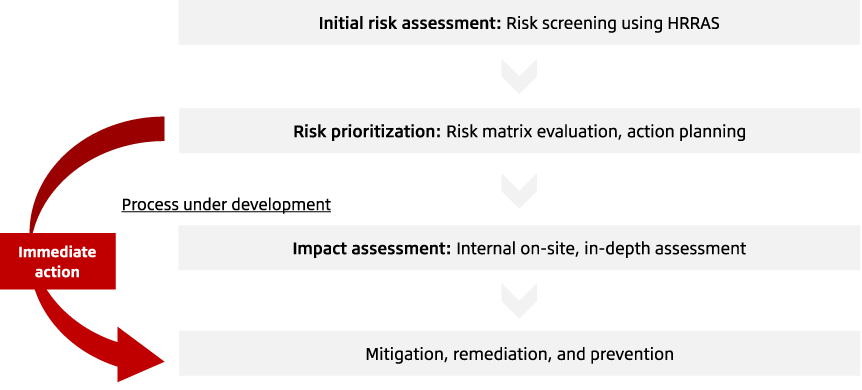
Regarding its own operations, in partnership with third-party experts and in alignment with the UNGPs, Bridgestone is significantly expanding and accelerating these efforts to ensure that it is meeting and exceeding societal expectations and continually strengthening its overall due diligence process. The process ensures engagement with internal and external stakeholders and that third-party experts are consulted throughout the following process.

* Sites that could be exposed to higher human rights risks due to geographic, political, social, industrial, or operational factors.

Respecting human rights standards

The Group’s Global Human Rights Policy

Bridgestone places the Global Human Rights Policy (GHRP) at the core of its human rights due diligence process, and the GHRP’s Implementation Guideline defines concrete actions and standards based on the GHRP. In 2024, the Group enhanced the Guideline by incorporating increasingly sophisticated social demands and legal requirements to respect human rights for all types of workers in close partnership with stakeholders and business partners. The Guideline aims to ensure that Bridgestone Group Companies around the world operate in compliance with the GHRP and realize Bridgestone’s policy commitment in their day-to-day operations. To meet this objective, the Guideline:

  1. Defines Bridgestone’s human rights standards to realize the commitment demonstrated in the GHRP;
  2. Provides guidance for Group Companies in implementing human rights risk management, including preventing and mitigating human rights risks and violations; and
  3. Defines concrete actions to respect the human rights of all workers, including Bridgestone employees and those who are employed by business partners who provide services to Bridgestone.

Bridgestone also emphasized stakeholder engagement during the process of updating the Guideline. With the support and advice of third-party human rights experts, the HRLP WG drafted the Guideline by referring to international human rights standards, including the International Charter of Human Rights, consisting of the UN’s Universal Declaration of Human Rights (UDHR). It also referred to the International Covenant on Civil and Political Rights (ICCPR), the International Covenant on Economic, Social and Cultural Rights (ICESCR), the ILO Declaration on Fundamental Principles and Rights at Work, the UN Guiding Principles on Business and Human Rights, and the OECD Guidelines for Multinational Enterprises. The Guideline was also reviewed by HR and legal professionals from all SBUs, as well as employees from Group Companies representing their regions, and was approved by the Sustainability Committee.

Overview of the Guideline

Targeted entities Bridgestone Corporation, regional head offices, subsidiaries
Table of Contents
Human Rights Domains covered in each chapter
  1. Forced Labor
  2. Child Labor and Young Workers
  3. Non-Discrimination and Diversity, Equity, and Inclusion (DE&I)
  4. Violence and Harassment at Work
  5. Working Hours
  6. Wages and Benefits
  7. Freedom of Association and Collective Bargaining
  8. Grievance Mechanism and Addressing Policy Violations
Scope of application All types of workers engaged in Bridgestone’s own operations, including employees and workers, contractors, consultants, and service providers/outsourced workers employed by third-party business partners
Implementation Guideline overview

Each content area defines prohibited actions as the Bridgestone Group’s human rights standards as well as actions to develop and implement human rights risk management processes. These actions are organized into three levels to help Bridgestone Group Companies progressively strengthen their risk management maturity level. The levels are defined as follows:

Minimum Requirements

Mandatory requirements that all Bridgestone Group Companies and their locations must implement as standardized procedures in day-to-day operations. These actions are what Bridgestone believes to be fundamental to strengthening its human rights management system, thereby contributing to sustainable value creation for society and customers and building trust with stakeholders.

Preferred Practices

Proactive actions to further strengthen the human rights risk management process of Group Companies and their locations.

Advanced Practices

Progressive actions in compliance with international human rights standards.

In addition to meeting national and regional legal obligations or defined standards, all Bridgestone Group Companies are required to comply with the minimum requirements defined in the Guideline, or with collective bargaining agreements, whichever ensures greater protection of the human rights of workers.

[PDF link to Guideline standards]

Identifying and assessing actual and potential adverse impacts

Bridgestone implements risk assessment processes to identify, evaluate, and prioritize actual and potential adverse impacts on human rights across Group operations.

In 2021, as a first step in the enhanced and expanded human rights due diligence cycle, Bridgestone partnered with two third-party organizations, Verisk Maplecroft and Business for Social Responsibility™ (BSR), to evaluate global operational risk exposure and identify salient human rights risks throughout its global operations.

Based on the evaluations, Bridgestone has identified its salient human rights issues: working hours, non-discrimination and equal opportunity, workplace harassment, forced labor, child labor, and occupational health and safety. These are the human rights domains that Bridgestone believes, based on a combination of geographical, regulatory, industrial, and operational factors, require the highest priority throughout its operations and are the primary focus of the human rights due diligence process at Bridgestone's operational sites.

For details of salient human rights issues, please refer to 2021 Risk Evaluation

Risk assessment process for Bridgestone’s own operations:

Initial risk assessment: Human Rights Risk Assessment Survey (HRRAS)

The HRRAS is the initial human rights risk assessment process Bridgestone uses to identify, evaluate, and prioritize potential human rights risks across its own operations by assessing the risk management maturity level and practices of Group Companies based on the Guideline. Bridgestone evaluates and prioritizes identified potential risks by assessing their severity, including scale, scope, and irremediability, as well as likelihood. Both the HRRAS and risk evaluation processes consider geographical and industry-specific risks as well as impacts on employees, non-employees, and potentially vulnerable groups of stakeholders, including children, young workers, migrants, LGBTQIA+ persons, persons with disabilities, and women.

Assessment categories

Overview of assessment categories can be found in Questions: PDF

Risk management policies, processes, and practices and reported and observed incidents regarding the following human rights domains:

  1. Forced Labor
  2. Child Labor and Young Workers
  3. Non-Discrimination and Diversity, Equity, and Inclusion (DE&I)
  4. Violence and Harassment at Work
  5. Working Hours
  6. Wages and Benefits
  7. Freedom of Association and Collective Bargaining
  8. Grievance Mechanism and Addressing Policy Violations
Assessment targets Bridgestone Corporation, regional HQs, subsidiaries
Method HRRAS self-assessment questionnaires

Impact assessment: internal on-site, in-depth assessment

Building on the insights and experience gained from assessments conducted by outside experts since 2022, Bridgestone is currently developing an internal in-depth assessment process. This process serves as a second line of defense to validate the results of the HRRAS, to identify actual adverse human rights impacts, and to ensure and support the effective implementation of the guidelines at Bridgestone’s operational sites. Bridgestone is developing this process with the support of both internal and external experts to ensure that it takes into consideration the impacts on rightsholders as well as the nature and inherent risks of each type of operation—including geographical and industry-specific risks. To this end, Bridgestone relies on a variety of data sources, such as industry benchmarks and standards, external geographic risk data, and internal assessment results. Bridgestone is working towards putting the in-depth assessment process in place by early 2027 and will provide updates on progress as available. For details of previous in-depth assessments, please refer to 2022-2023 in-depth assessments

Ceasing, mitigating, and remediating adverse impacts

Bridgestone implements a systematic process to cease and remediate actual adverse impacts on human rights and the environment identified as part of the due diligence process for its own operations. Bridgestone analyzes the cause or activities contributing to the identified adverse impact, and its nature, to develop a plan to cease, mitigate, and prevent the impact. Bridgestone also consults and engages with impacted stakeholders and/or their representatives to devise appropriate actions and implement the plan.

After launching its renewed Guideline with enhanced human rights standards in December 2024, Bridgestone also updated and conducted the HRRAS as a baseline assessment in July 2025 to evaluate the risk management maturity of Group Companies in light of the new standards. Based on the 2025 HRRAS results, Bridgestone will continue to standardize and strengthen the effective implementation of the Guideline across all operations. Details of the HRRAS results and mitigation plans are provided below.

2025 HRRAS results

2025 Assessment Targets Targets Assessed % of Total Assessed Identified Areas of Improvements
146 Group Companies 146 Group Companies 100% 5 areas
Human Rights Domain from the Guideline Guideline Standards Areas of Improvement Improvement and Mitigation Measures Status
Grievance Mechanism and Addressing Policy Violations IG VIII. 2. (c)
BridgeLine as a formal confidential communication system where workers can report issues of concern related to the prohibited actions defined in their company’s policy
Papua New Guinea:
BridgeLine was not available

1) Introduction of BridgeLine system

2) Providing training for managers and information to all workers about the purpose and use of BridgeLine

Completed in Dec. 2025
Forced Labor IG I. 2. (a)
Prohibition of levies, recruiting, hiring, or placement fees or costs to be paid by workers
Taiwan:
Migrant workers charged recruitment fees by a staffing agency, as permitted under local law or in accordance with legally allowed practices
Requested staffing agency to end the practice and contractually agreed with the agency that no recruitment-related fees will be collected from workers by the agency Completed by Jun. 30 2026
Child Labor and Young Workers IG II. 2. (d)
Prohibition of night work and overtime performed by young workers under the age of 18.
Australia:
Young workers under 18 (U18) periodically worked overtime but remained within the legal limits
Established Human Rights Labor Practices policy to prohibit overtime for young workers under 18 Completed by Jun. 30 2026
Non-Discrimination and DE&I IG. III. 1. (6)
Prohibition of Unlawful medical testing for physical exam, pregnancy, virginity, and HIV/AIDS and use of contraception as a condition of employment
Thailand:
Lawful pregnancy tests administered during medical screening for employment or pre-employment medical examination
Practice terminated Completed by Jan. 2026
Non-Discrimination and DE&I Malaysia:
Lawful HIV test administered during medical screening for employment or pre-employment medical examination
Practice terminated Completed by Jan. 2026

External human rights audits

In response to customer requests, Bridgestone accepts and participates in on-site human rights audits. It considers engaging in such audits to be essential to being a trusted partner, and to also contribute to enhancing human rights risk management levels.

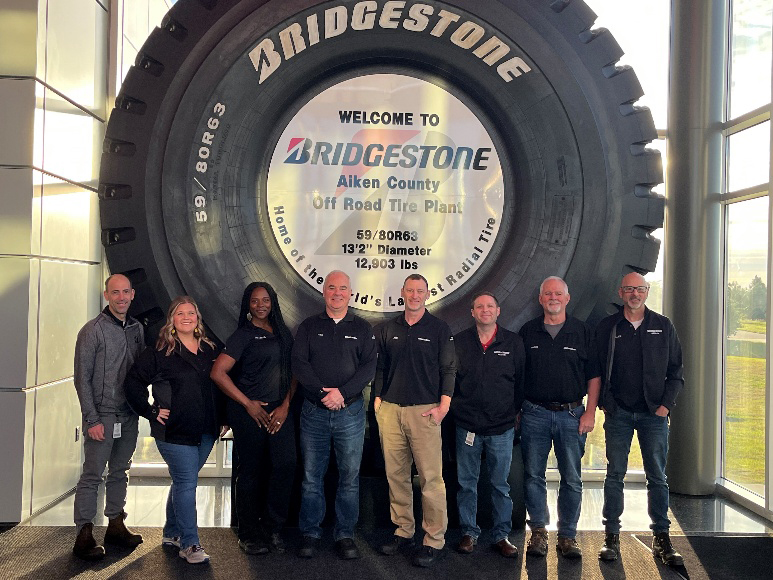
In September 2025, Bridgestone underwent a Sedex SMETA audit at its Aiken Off-the-Road Tire (OTR) plant located in South Carolina in the United States. This facility produces large and ultra large off road radial tires. Sedex SMETA is one of the most widely recognized social audit frameworks, assessing labor standards, health and safety, environmental performance, and business ethics. Across these four pillars, the audit found the Aiken OTR tire plant to be compliant with SMETA requirements and to demonstrate robust management systems. In the area of human rights, local policies and procedures, supported by global disclosure, further reflected the plant’s level of maturity. Building on an opportunity identified during the audit, Bridgestone will continue to advance its human rights efforts by exploring the feasibility of conducting living‑wage analyses where appropriate.

Comment by Chris Barden, Aiken OTR Plant Manager

At the Aiken OTR plant, we are committed to respecting human rights and advancing labor practices in alignment with the Bridgestone Group’s Global Human Rights Policy. In support of this commitment, we welcomed the selection of our plant for the SMETA audit at the request of our customer, BHP. We were pleased that the results confirmed our compliance with the expected standards, demonstrating the value we share with our customers. Beyond simply responding to audits, we believe that these positive results are a recognition of our glocal team efforts and partnership, which bring together our global strategies, the thorough and sincere support from the SBU, and the steadfast commitment of local teams to putting the Bridgestone Group’s commitment into daily operations.

Tracking implementation and results

Bridgestone conducts periodic assessments using the HRRAS to monitor improvement in risk management maturity levels and practices across its operations.

In addition, Bridgestone is developing an assessment process to monitor and track the implementation and effectiveness of mitigation and remediation measures. Assessing effectiveness involves evaluating not only whether actions have been taken but also whether they achieve meaningful results in preventing, mitigating, or ending adverse impacts. The process will consider a combination of qualitative and quantitative indicators, including the satisfactory resolution of identified risks, reductions in recurrence, stakeholder feedback, and the achievement of milestones set out in corrective action plans. Bridgestone is working towards establishing the assessment process by early 2027 and will provide updates on progress as available.

Embedding human rights commitments into Bridgestone’s own operations: A case study of “glocal” efforts at Firestone Liberia

The Bridgestone Group engages in a wide range of operations, including multiple operational locations across the globe, ranging from the extraction of raw materials to manufacturing, services, and sales. Bridgestone owns four natural rubber companies in Liberia, Indonesia, and Thailand, each of which plays a critical role in procuring and supplying the natural rubber that is essential to its entire business. It is a core mission of Bridgestone to ensure the sustainability of the natural rubber business—not only to prevent adverse impacts on society and local communities but also to promote mutual growth and shared prosperity with stakeholders.

Firestone Liberia (FSLB) is one of the largest natural rubber farms, owned by Bridgestone and operated with the support of and in partnership with various stakeholders and communities. As part of the Bridgestone Group, FSLB is firmly committed to respecting human rights and advancing responsible labor practices throughout its operations in compliance with Bridgestone's Global Human Rights Policy (GHRP) and its Implementation Guideline as well as with the Global Sustainable Procurement Policy. FSLB also fulfills its responsibility to ethical business practices, transparency, and adherence to the laws of Liberia, including the provisions of FSLB’s concession agreement.

This commitment is reinforced through the partnership between the Bridgestone Corporation, the regional HQ, and local FSLB teams. As part of the Bridgestone's human rights due diligence process, FSLB and the regional HQ responsible for managing its business operations review and ensure that FSLB’s policies and processes are aligned with the GHRP and its Guideline. FSLB also participates in the Bridgestone's periodic HRRAS assessments and supports field visits from the Bridgestone Corporation and the regional HQ, which allow all teams to reaffirm that FSLB is maintaining a consistent commitment to human rights.

Furthermore, in light of Liberia’s unique socio-economic context and FSLB’s exposure to potential human rights and environmental risks associated with geographical and industry factors, FSLB takes additional steps to strengthen its risk management system beyond Group-wide measures. These include utilization of the International Sustainability and Carbon Certification PLUS (ISCC PLUS), which enables FSLB to ensure—from an independent perspective—that it is implementing appropriate human rights risk management while taking into account its business context as a natural rubber farm.

Since the acquisition of ISCC PLUS certification in 2023, FSLB has been participating yearly in external audits, focusing on deforestation-free activities, environmental risk management, safe working conditions, and responsible sourcing. Based on the findings of these audits, FSLB has reinforced its programs involving health and safety, specifically related to the handling of chemicals and immediate response capability. FSLB has also developed and begun implementing an internal audit process to regularly monitor worker rights compliance, which includes the labor standards and practices of contractors, as well as the working and living conditions of contracted workers, including benefits and compensation. See the FSLB ISCC PLUS certification PDF

FSLB’s activities go beyond simply conducting responsible business. In Harbel, Liberia, where FSLB operates, state-provided basic infrastructure—such as water supply, sanitation, electricity, education, and healthcare—remains limited. Recognizing the crucial role the private sector plays in the welfare of the Liberian economy, FSLB is committed to supporting its employees and contracted workers and the communities in and around the concession by providing access to essential services, such as healthcare, education, drinking water, and housing, to the extent that a single private company can. With regard to healthcare in particular, FSLB ensures that contracted workers have the same level of access as its own employees, including their dependents. Other examples include regular testing of drinking water quality, collecting and cleaning latrine tanks, and supporting contractors in acquiring school buses for their workers’ dependents, among other initiatives.

At the same time, FSLB recognizes the limitations of these efforts and actively engages with communities and stakeholders, leveraging their feedback to drive continuous improvement. In addition to Bridgestone's official hotline, BridgeLine, FSLB has established another channel that enables all stakeholders to raise questions or concerns.

In 2025, FSLB launched a toll-free 9494 channel open to all stakeholders, operated in partnership with a local third-party advisory firm specializing in governance and responsible sourcing. Due to technology and infrastructure, this additional Speak Up channel allows for easier, more reliable call connections. Reports are received by the advisory firm and forwarded to the FSLB team for further review, investigation, and resolution if appropriate. Reporters who provide contact information are given regular updates throughout the process, ensuring transparency and predictability. FSLB also values securing safety and fostering the trust of stakeholders by breaking down barriers, promoting dialogue, and empowering stakeholders to raise their concerns.

FSLB appropriately handled all reported cases in 2025 and put resolutions in place when needed, resulting in the closure of all outstanding cases registered that year. Consistent with concerns raised through any Speak Up channel, matters are promptly investigated by the appropriate function and in accordance with Bridgestone’s internal investigation procedures to properly observe the privacy and confidentiality of those involved.

FSLB and other members of Bridgestone continue to take sincere efforts to address concerns and consistently turn issues into opportunities for improvement, aiming to become a trusted partner for all stakeholders.

Human rights training

Initiative for raising awareness of HR professionals

Each Bridgestone SBU is planning a series of various learning and training opportunities to raise awareness and increase education regarding Bridgestone’s human rights commitment among employees at all levels across all Group Companies, including top management, HR professionals, and on-site employees.

Regional initiatives

・Bridgestone West - Americas, Europe, Middle East, and Africa regions:

Bridgestone West shared an update on its human rights initiatives during an HR Community call that brought together the global HR function (Talent Acquisition, Talent Management, Total Rewards, HR Business Partners, and others) from across the Americas, Europe, Middle East, and Africa regions to maximize awareness and visibility. Additionally, it promoted the new Implementation Guideline through multiple, dedicated training sessions for HR professional with local responsibilities, focused on incorporating the Guideline's requirements into the main HR operational processes affecting employee lifecycles. These sessions also highlighted the broader activities managed by the HRLP WG and initiated an open discussion, allowing participants to express concerns, identify gaps, share best practices, and find common solutions. This same group took part in the Human Rights Risk Assessment Survey (HRRAS), which was launched in the second half of 2025 in coordination with the HRLP WG. Bridgestone WEST believes that establishing an informal human rights community within Bridgestone West is a critical step in reinforcing due diligence efforts. By enhancing awareness, promoting consistent practices, and fostering collaboration across countries, this community can help prevent potential violations and contribute to the development of a stronger human‑rights culture throughout the organization.

・Asia Pacific, India, and China region:

Bridgestone Asia Pacific, India, and China (BSAPIC) conducted a briefing session for all Group Company HR personnel to explain the new Guideline's requirements and launched the Guideline implementation activities. In parallel, BSAPIC HRLP Team continues to guide and support Group Company HR teams in addressing concerns, sharing best practices, and developing improvement plans. In the second half of 2025, BSAPIC Group Companies participated in the HRRAS to assess updated HRLP policies and procedures, identify gaps, and develop mitigation plans for further improvement.

・Japan:

Japan segment trains relevant HR staff in Group Companies by conducting briefing sessions on the Guideline. During these sessions, the segment highlights key points for implementing the Guideline and shares best practices. It also addresses any concerns or challenges that may arise during implementation. Japan segment aims to foster support from representatives and HR staff in each Group Company through consistent efforts to promote the implementation of the Guideline. Group Companies in the segment also participated in the HRRAS in the second half of 2025 and completed improvements by January 2026. In 2026, Bridgestone will promote the establishment of standardized procedures for the minimum requirements of the Implementation Guideline and strengthen their execution.

Global Human Rights Policy and Code of Conduct training for all employees

Bridgestone conducts regular education on its Global Human Rights Policy and Code of Conduct. It conducted human rights training in 2023, and 30,040 employees (94.7% of targeted employees) participated in the training in 2024. All managers are trained regularly on the Code of Conduct, including on the topics of harassment and bullying.

The HRLP WG is collaborating with the Global Procurement Committee and the Global Sustainability Function to enhance Bridgestone’s human rights training programs as part of the HRLP WG’s global due diligence and risk assessment process. Program content is designed to further build awareness of the specific contexts and causes of human rights impacts, to understand the relationship between business activities and human rights, and to forge a deeper understanding of the importance of human rights throughout the value chain.

Speaking up, reporting concerns

To help ensure compliance with the Global Human Rights Policy, Bridgestone provides Group employees and all stakeholders (including contractors, suppliers, consumers, and customers) with several different options to seek help with questions or raise concerns. As outlined in the Bridgestone Code of Conduct, this includes supervisors, the Human Resources Department, the Legal & Compliance Risk Management Division, the Chief Compliance Officer for the region, and the Internal Audit Department, as well as a third-party operated reporting channel referred to as the “BridgeLine.”

Bridgestone encourages speaking up and will ensure that anyone can do so safely and securely. It protects confidentiality and anonymity to the fullest extent permitted under local law for all who submit a report through BridgeLine. Bridgestone prohibits retaliation and has zero tolerance for acts of reprisal of any kind against anyone who makes a report in good faith.

BridgeLine

Relevant Information

Sustainability